Free Games
 How to play Pyramid Solitaire
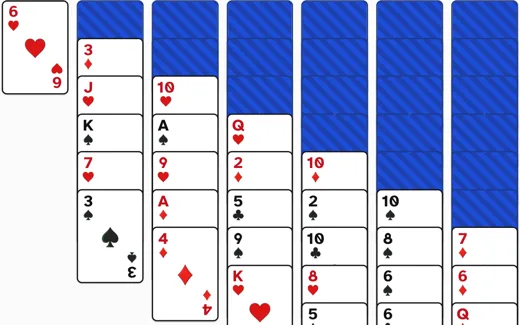
Pyramid is a solitaire game built on one idea: find two cards that add up to 13. Twenty-eight cards are dealt into a pyramid of seven rows, and the rest wait in a face-down deal pile. Tap two uncovered cards that make 13 and they vanish. Clear the whole pyramid and you win.
The rules in plain words
- Number cards are worth their number. An Ace is 1, a Jack is 11, a Queen is 12 and a King is 13.
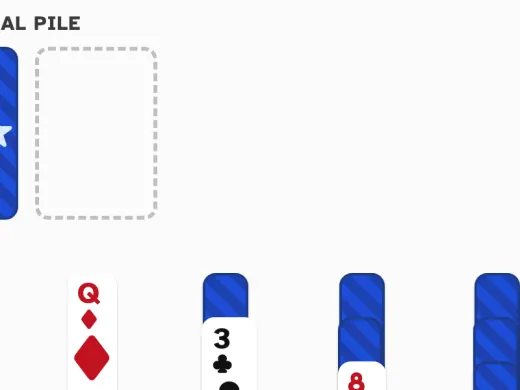
- A pyramid card can only be used when it is uncovered: no card from the row below may be resting on it. The bottom row is ready from the start; covered cards look grey and wait their turn.
- A King makes 13 all by itself, so one tap removes it. No partner is needed.
- Tap the deal pile to turn over a fresh card. The top card of the waste pile can pair with any uncovered pyramid card.
- When the deal pile runs out, tap it once more and the waste turns back over, and you can deal through the cards as many times as you like.
Every pair that makes 13
There are six pairs to remember, plus the King, which goes alone:
| This card… | …pairs with |
|---|---|
| Ace (1) | Queen (12) |
| 2 | Jack (11) |
| 3 | 10 |
| 4 | 9 |
| 5 | 8 |
| 6 | 7 |
| King (13) | Nobody, one tap removes it |
How to make a move
There is no dragging. Tap a card to pick it up. It lifts and shows a “picked up” tag, and the game tells you which partner it needs. Then tap the matching card and both are removed. Change your mind? Tap the same card again to put it back. If two cards do not make 13, nothing bad happens. The game explains the sum and lets you try again.
Tips for clearing the pyramid
- Work on the pyramid first. Removing pyramid cards is what wins the game, so when you can choose, prefer a pair that uses pyramid cards over one that leans on the waste pile.
- Take Kings whenever you see them. They need no partner and they uncover the cards beneath.
- Peek before you pair. Two uncovered pyramid cards that make 13 are usually better than using a dealt card, but if a pair would block another, the Hint button will find a good one for you.
- Do not worry about the deal pile. With unlimited redeals and unlimited Undo, you can play a hunch and undo it if it does not pan out.
Large print and no pressure
The cards are large and bold, with the rank printed in both top corners and a clear suit picture in the middle, so every card stays readable even when rows overlap. There is no timer or score against you, and no “game over” screen. The Hint button finds the next step: a pair, a lone King, or “deal a card.” Press it twice and it makes the move for you.
Frequently asked questions
- How do I play Pyramid Solitaire?
- Tap two cards that add up to 13 to remove them, for example a 6 and a 7, or an Ace (worth 1) and a Queen (worth 12). Kings are worth 13 on their own, so a single tap removes a King. Only uncovered cards can be used. Tap the deal pile for a fresh card whenever you need one. Clear the whole pyramid and you win.
- Which cards add up to 13?
- Ace and Queen, 2 and Jack, 3 and 10, 4 and 9, 5 and 8, 6 and 7. A King counts as 13 all by itself, so it goes alone. That is the whole list.
- What happens when the deal pile runs out?
- Tap the empty deal pile and the waste cards turn back over, so you can deal through them again. There is no limit on redeals.
- Is there a timer or a way to lose?
- No. There is no clock or score against you, and no “game over” screen. The Undo button steps back through every move. If a deal will not work out, start a fresh one.
- Is it really free?
- Yes. It is free, you do not need to download anything, and you do not need to sign up or give an email. There are no pop-ups and nothing that sits over the cards. To keep the site free I may show a few small, clearly-marked ads off to the side.
Klondike Solitaire, the game most people mean by the word solitaire, has its own page.
Where Pyramid Solitaire came from
Pyramid is a single-player card game built around a triangle of overlapping cards, cleared by pairing two cards that add up to thirteen, with kings removed on their own since a king already counts as thirteen. Like several other single-player card games of this shape, its early history was not well recorded, and no clear inventor or date has come down to us.
Card games built around pairing two cards to reach a target number, rather than building runs or sorting suits, seem to have been played in various forms for a long time before anyone wrote down where they began. What has survived is the game itself: the triangle of cards, the pairs that clear it, and a stock pile to work through when nothing on the board matches yet. It sits well beside my other card games.