Free Games
 How to play TriPeaks
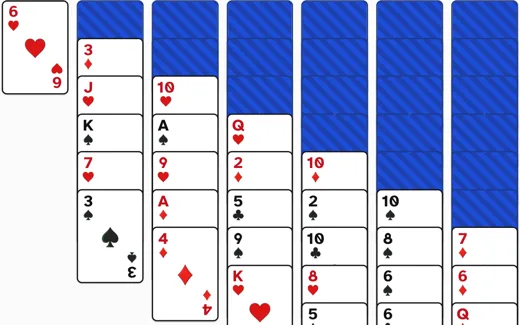
TriPeaks, which plenty of people write as Tri Peaks, deals 28 cards into three peaks: three peak tops, two rows tucked beneath them, and an open bottom row of ten face-up cards. One more card starts the pile, and the remaining 23 wait in the stock.
There is only one move to learn: tap any open card that is one higher or one lower than the pile card. It hops onto the pile and becomes the new number to match. Suits and colors never matter. When a card is cleared, any card it was pinning down turns face up, which is how you dig your way up to the three peaks. Clear all 28 cards and you win. When nothing on the board connects, tap the stock to deal a fresh pile card.
One higher, one lower, and Aces wrap around
If the pile shows a 7, you may play a 6 or an 8. The ranks join in a circle: an Ace connects to both a King and a Two. So on a King you can play a Queen or an Ace, and on an Ace you can play a King or a Two. Long chains like Queen → King → Ace → Two clear several cards in a row.
Tips
- Look for a run before you deal. Each stock card counts, so play every chain you can find first. The Hint button can point one out.
- Prefer moves that turn a card over. When two cards would both work, pick the one that frees a face-down card underneath.
- Clear toward the peaks. Working the tall stacks early opens more of the board than nibbling at the edges.
- Undo is unlimited. Rewind as far as you like and try another path.
Running out of cards
There is no timer or score pressure, and running out of cards is not a “game over”: a Start fresh button deals a new game. Pyramid Solitaire and Golf Solitaire also clear cards from a layout.
Where TriPeaks Solitaire came from
TriPeaks is one of the newer games on this site, and unlike most of the card games here it has a documented birth: it is generally credited to Robert Hogue, who designed it in 1989 for Microsoft's Windows Entertainment Pack, a collection of computer games, rather than for play with a physical deck.
The layout gives the game its name, three overlapping peaks of cards dealt face down and face up, cleared by working outward from a single open card at the bottom in a chain of cards one rank higher or lower than the last. It was built for a screen from the start, so it plays here the way it always has. Try it with my other card games.